Friday, March 14, 2025

Technical Session Chair at 26th IEEE INMIC Conference organized by SHU

December 30-31, 2024

Hamdard University BME alumni from abroad presented their research work in poster form at the 26th IEEE INMIC conference, organized by SHU. I co-chaired a session with Dr. Raja Masood Larik of NED UET on the second day of the conferece.  


Tuesday, March 11, 2025

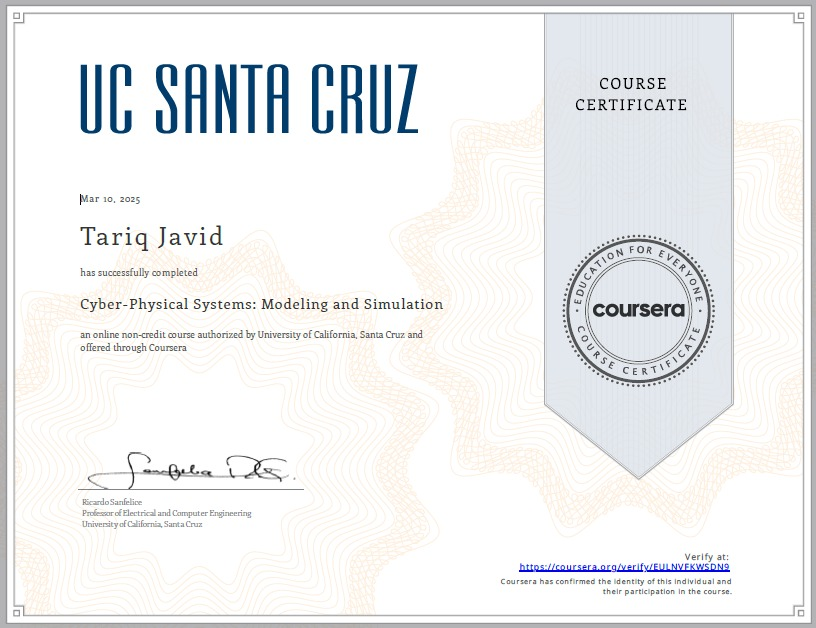
Completion of CPS Course

10 March 2025

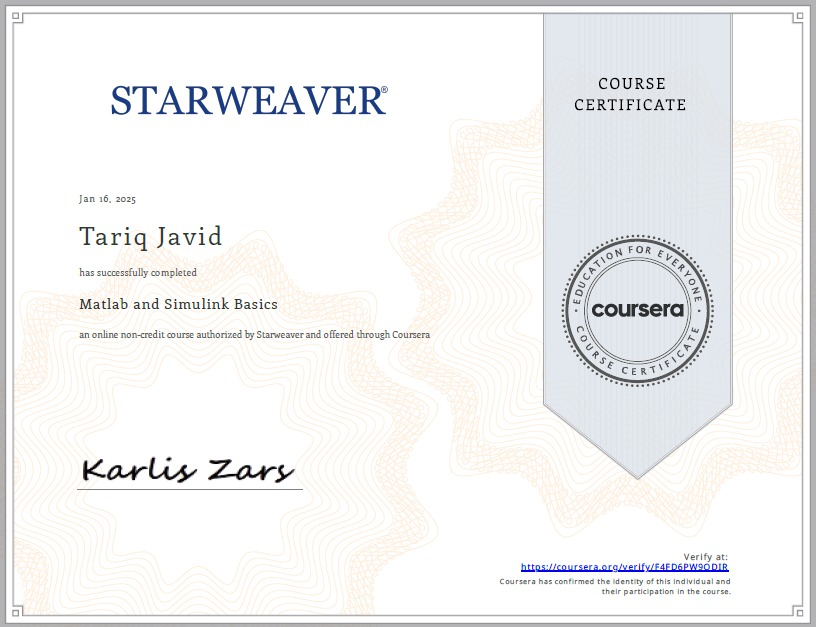
The CPS course completed after about three months of learning. This is a very good and hands-on course. The resource person was Prof. Ricardo Sanfelice, Chair at the Department of Electrical and Computer Engineering, University of California at Santa Cruz. In order to complete the course, I have to complete another course to refresh MATLAB and to gain insights of Simulink. Thanks to HEC Digital Learning & Skills Enrichment Initiative Pakistan and Hamdard University for providing the opportunity to learn from the top of line academicians and researchers, aka, subject experts.


Friday, February 28, 2025

Biomedical Engineering Students Awarded Gold Category at 40th All Pakistan IEEEP Students' Seminar

20th February 2025

Hamdard University Biomedical Engineering students: Ms. Ramsha Qayyum, Ms. Khadija Razi, and Ms. Fakiha Arshad awarded Gold Category for the oral presentation of accepted research paper entitled, "Skin Disease Detection through Hybrid Deep Learning Method," at 40th All Pakistan IEEEP Students' Seminar, held at Salim Habib University, Karachi, on 20th February 2025. The research work was supervised by Dr. Muhammad Faris, Assistant Professor BME. 


Attended: 8th All Pakistan DUHS-DICE Health Innovation Exhibition

25th February 2025

The 8th All Pakistan DUHS-DICE Health Innovation Exhibition 2025 was organized collaboratively by the Dow University of Health Sciences and DICE Foundation, USA. The event was held at DUHS Ojha Campus on 25th February 2025. 


Saturday, February 1, 2025

Group Photo: Faculty of Engineering Sciences and Technology, Hamdard University, Karachi Campus

Tuesday 28th January 2025


Attending One-Day:Masterclass in Health Information Systems Global Perspective

Thursday 30th January 2025

Dr. Tariq Javid attended a one-day session entitled, Masterclass in Health Information Systems: Global Perspective." The session was organized by the Department of Biomedical Engineering, NED University of Engineering and Technology, LEJ Campus, Karachi; and held on Thursday 30th January 2025. The session started with a welcome speech by Prof. Dr. Eraj Humayun Mirza, Chair BME, NED UET, and a brief speech by Prof. Dr. Saad Ahmed Qazi, Meritorious Prof. & Dean Faculty of Electrical and Computer Engineering, NED UET. Prof. Dr. Maryati Mohd Yusof from Universiti Kebangsaan Malaysia was the resource person. The session was about the use of three life cycles: Plan-Do-Act-Check (PDAC) - a quality management methodology, Software Development Life Cycle (SDLC), and Business Process Management (BPM); as an integrated tool for identifying the errors and addressing the root cause. The first half was on the introduction of the health information system (HIS). After the prayer break and lunch, the second session - activity-based - was held. The session concluded by awarding certificates to participants and a group photograph. 


Friday, October 4, 2024

Demystifying the Shortest Path Algorithm with Example

Demystifying the Shortest Path Algorithm with Examples

Saturday 05 October 2024

Consider the complete network in Fig. 1, to find the shortest path from A to H using the Dijkstra algorithm [1]. A simple inspection reveals the optimal path ABEFGH with cost 10. However, implementing the algorithm through a computer program deserves some attention. 

Figure 1 

The procedure excerpt from [2]. 

Step1. A is marked. The nodes connected directly to A are labeled with (cost, from node). All other nodes in the network are labeled with (infinity, dash). B is marked for the next step due to lower cost than C, Fig. 2.

Figure 2

Step2. The nodes connected directly to B are relabeled with (cost, from node). E is marked for the next step due to lower cost than C and D, Fig. 3.

Figure 3
Step3. The nodes connected directly to E are relabeled with (cost, from node). F is marked for the next step due to lower cost than C and D. 

Step4. The modes connected directly to F are relabeled with (cost, from node). G is marked.

Step5. Figure 4 shows the optimal path from A to H: ABEFGH.

Figure 4

There are a lot of posts on the net. A good one is [3]. The Python code was modified for the above example and results are shown in Fig. 5. 

Figure 5

References: 

[1] Dijkstra (1959), [2] CN 6th Tanenbaum, [3] www.dougmahugh.com/dijkstra

Appendix: Output 

Reading the input file ...

('A', 'B', 2.0)

('A', 'C', 6.0)

('B', 'D', 7.0)

('B', 'E', 2.0)

('C', 'E', 1.0)

('C', 'G', 4.0)

('D', 'F', 3.0)

('D', 'H', 3.0)

('E', 'F', 2.0)

('F', 'G', 2.0)

('G', 'H', 2.0)

Building Adjacency List ...

{'C': {('E', 1.0), ('G', 4.0)}, 'F': {('G', 2.0)}, 'G': {('H', 2.0)},

'A': {('C', 6.0), ('B', 2.0)}, 'H': set(), 'E': {('F', 2.0)},

'B': {('D', 7.0), ('E', 2.0)}, 'D': {('F', 3.0), ('H', 3.0)}}

Unvisited Nodes ...

{'C', 'F', 'G', 'A', 'H', 'E', 'B', 'D'}

Distance from Start Node

{'C': inf, 'F': inf, 'G': inf, 'A': 0, 'H': inf, 'E': inf, 'B': inf, 'D': inf}

Current node =  A

Unvisited nodes =  {'C', 'F', 'G', 'H', 'E', 'B', 'D'}

neighbor =  C  distance =  6.0

New path =  6.0

neighbor =  B  distance =  2.0

New path =  2.0

Current node =  B

Unvisited nodes =  {'C', 'F', 'G', 'H', 'E', 'D'}

neighbor =  D  distance =  7.0

New path =  9.0

neighbor =  E  distance =  2.0

New path =  4.0

Current node =  E

Unvisited nodes =  {'C', 'F', 'G', 'H', 'D'}

neighbor =  F  distance =  2.0

New path =  6.0

Current node =  C

Unvisited nodes =  {'F', 'G', 'H', 'D'}

neighbor =  E  distance =  1.0

neighbor =  G  distance =  4.0

New path =  10.0

Current node =  F

Unvisited nodes =  {'G', 'H', 'D'}

neighbor =  G  distance =  2.0

New path =  8.0

Current node =  G

Unvisited nodes =  {'H', 'D'}

neighbor =  H  distance =  2.0

New path =  10.0

Current node =  D

Unvisited nodes =  {'H'}

neighbor =  F  distance =  3.0

neighbor =  H  distance =  3.0

Current node =  H

Unvisited nodes =  set()

graph definition file: simple_graph3.txt

      start/end nodes: A -> H

        shortest path: ['A', 'B', 'E', 'F', 'G', 'H']

       total distance: 10